| |
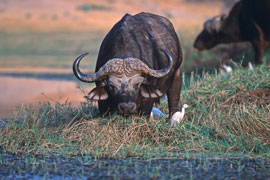 Buffalo
are extremely large, ox-like animals. Standing approximately 65 inches
at the shoulder, adult males have a mass of up to 1760 pounds and
females weigh up to 1650 pounds. To support the large body, the legs are
very heavy. Front hooves are larger than the hind because of the extra
mass they carry in the huge head and thick neck. Both sexes carry horns,
which in the males can grow to 1.5m. Buffalo varies considerably in
size, with some of the forest populations half the size of those from
the plains and Savannah. Buffalo
are extremely large, ox-like animals. Standing approximately 65 inches
at the shoulder, adult males have a mass of up to 1760 pounds and
females weigh up to 1650 pounds. To support the large body, the legs are
very heavy. Front hooves are larger than the hind because of the extra
mass they carry in the huge head and thick neck. Both sexes carry horns,
which in the males can grow to 1.5m. Buffalo varies considerably in
size, with some of the forest populations half the size of those from
the plains and Savannah.
|
|
Quick Facts |
|
Habitat: Dense forest to open plains.
Plentiful supplies of grass, shade and water are essential habitat
requirements for the savannah buffalo. They avoid wide open areas and
flood plains which are far from shade. Buffalo drink regularly, often
twice a day, and they frequently remain in the vicinity of water when
feeding |
| |
|
Diet: Herbivorous grazers. Buffalo graze
almost exclusively, but do include a small amount of browse in their
diet. |
| |
|
Socialization: Buffalo are gregarious,
occurring in herds of up to several thousand. In the wild they are known
to have lived up to 18 years |
| |
|
Reproduction: Cows become sexually mature
at +/- 3 years of age. The majority have their first calf at five years
old and one thereafter every other year. Males that are 7 years or older
usually mate with the females. |
| |
|
Gestation: The gestation period is from 330
to 346 days and a single calf is born. Calf mortality is high with only
about 20% reaching maturity. |
| |
| |