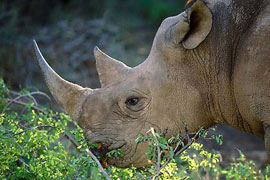
The rhinoceros is a large, primitive looking
mammal that in fact dates from the Miocene era
millions of years ago. In recent decades rhinos
have been relentlessly hunted to the point of
near extinction. Since 1970 the world rhino
population has declined by 90 percent, with five
species remaining in the world today, all of
which are endangered.
The white or square-lipped rhino is one of two
rhino species in Africa. It in turn occurs as
two subspecies, the southern and the northern.
The southern dwindled almost to extinction in
the early 20th century, but was protected on
farms and reserves, enabling it to increase
enough to be reintroduced. The northern white
rhino has recovered in Democratic Republic of
Congo from about 15 in 1984 to about 30 in the
late 1990s. This population has been threatened
by political conflict and instability.
Quick Facts
Name: Black Rhinoceros - Diceros bicornis
Name: White Rhinoceros - Ceratotherium simum
The White Rhino: The white rhino's name derives from the Dutch "weit," meaning wide, a reference to its wide, square muzzle adapted for grazing. The white rhino, which is actually grey, has a pronounced hump on the neck and a long face.
The Black Rhino: The black, or hooked-lipped rhino, along with all other rhino species, is an odd-toed ungulate (three toes on each foot). It has a thick, hairless, grey hide. Both the black and white rhino have two horns, the longer of which sits at the front of the nose.
Size: The rhinoceros stands about 60 inches at the shoulder.
Weight: Black Rhino: 1 to 1½ tons. White Rhino: over 2 tons.
Habitat: Grassland and open savannahs. Black rhinos have various habitats, but mainly areas with dense, woody vegetation. White rhinos live in savannahs with water holes, mud wallows and shade trees.
Diet: Vegetarian. Black Rhino - browser. White Rhino - grazer.
Diet Description: The black rhino is a browser, with a triangular-shaped upper lip ending in a mobile grasping point. It eats a large variety of vegetation, including leaves, buds and shoots of plants, bushes and trees. The white rhino is a grazer feeding on grasses.
They have an extended "vocabulary" of growls, grunts, squeaks, snorts and bellows. When attacking, the rhino lowers its head, snorts, breaks into a gallop reaching speeds of 30 miles an hour, and gores or strikes powerful blows with its horns. Still, for all its bulk, the rhino is very agile and can quickly turn in a small space.
The rhino has a symbiotic relationship with oxpeckers, also called tick birds. In Swahili the tick bird is named "askari wa kifaru," meaning "the rhino's guard." The bird eats ticks it finds on the rhino and noisily warns of danger. Although the birds also eat blood from sores on the rhino's skin and thus obstruct healing, they are still tolerated
Lifespan: 35 to 40 years.
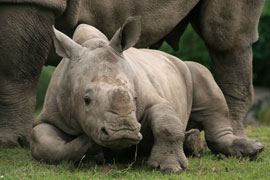
Reproduction: Young are born after a gestation period of 16 months.